
Outdoor Sound & Lighting Guide
How to spec a PA, cover a crowd, light the stage, and feed the whole rig with power when the show doesn't have four walls and a ceiling — from the GPS production crew.
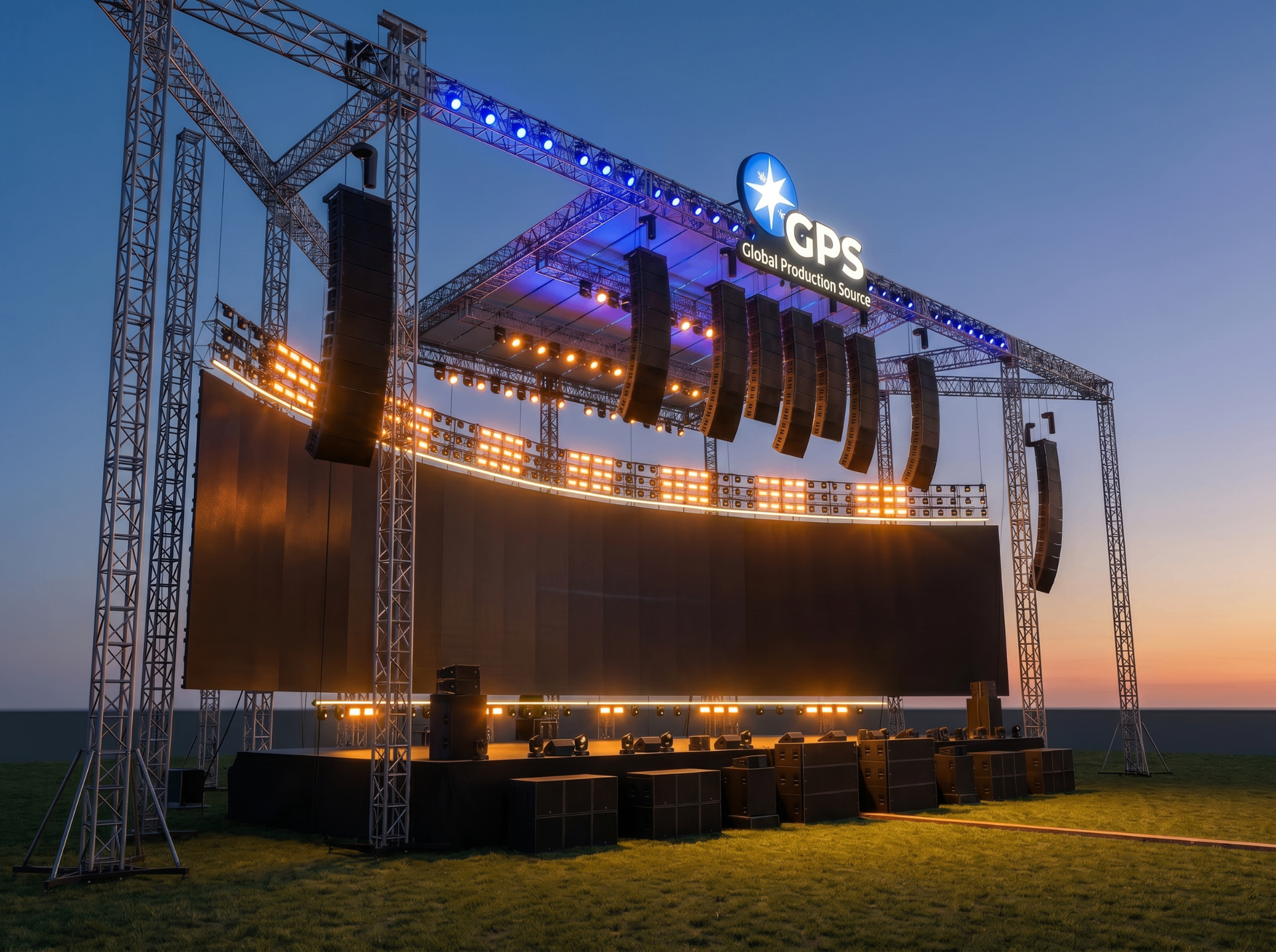
Why outdoor is different
Indoors, the room does half the work. Walls reflect sound back into the audience, a ceiling contains haze so beams read, and ambient light stays constant from doors to encore. Outdoors, none of that helps you. Sound radiates and dies with distance, haze blows away, and the LD is chasing a sun that moves through three completely different lighting looks between soundcheck and the last song.
That means every spec decision — PA size, coverage, fixture selection, power — has to plan for the environment, not fight it. The rest of this guide walks the calls we make on outdoor builds every weekend.
Sizing the PA
Start with two numbers: how many people are watching, and how far the back of the crowd is from the stage. Attendance sets the sheer output you need; throw distance decides whether a point-source system can cover it or whether you need a line array.
- Under 500 people, short throw. A well-tuned point-source system per side with a pair of subs is usually plenty.
- 500 – 2,000 people. Compact line array (6–8 boxes per side) with a dedicated sub array. This is the sweet spot for most park events and mid-size festivals.
- 2,000+ or throws past 100 feet. Full line array with cardioid or end-fire sub arrays and a system tech running measurement software during setup.
GPS models every venue in prediction software before load-in so the boxes, angles, and timing are right before a truck moves. If you're still deciding on the PA package, the line array spec sheet walks the scaling options.
Coverage and delay towers
A line array's coverage falls off predictably with distance. The first 100 feet from the boxes stays tight; from 100 to 150 feet you start to hear the top end soften; past 150 feet the front-back consistency really starts to slip. Delay towers fix that by placing a second (or third) coverage ring further into the crowd, time-aligned back to the mains.
- First delay ring: around 150 feet from the stage.
- Second delay ring: another 120 to 150 feet beyond that if the crowd is deep.
- Bonus: delays let you turn the main PA down, which helps with noise ordinances and neighbor complaints.
Lighting for outdoor shows
An outdoor lighting design lives three lives in one night: full sun during load-in and often opening acts, golden-hour sunset when the rig starts to read, and full dark when the show finally looks like the pre-vis. Program to full dark, but always plot a wash and a front-fill that keeps the artist visible in every phase.
Fixture roles
- Wash: broad color and stage cover. High-output LED wash fixtures earn their weight outdoors.
- Beam: aerial looks and audience effects. Choose fixtures with tight enough beam angles to punch through open air.
- Spot: gobos, prisms, and key light on the artist.
- Strobe: impact hits. Outdoors, you need more intensity than an indoor rig to get the same visual weight.
IP ratings and haze
Fixtures under a certified stage roof usually don't need to be IP-rated. Fixtures on ground-support truss out in the open, or on delay towers, should be IP65 so a rain shower doesn't kill the show. Haze rarely works outdoors — even a light breeze pulls it apart before it reaches the audience — so most outdoor designs lean on beam intensity and low-fog for ground effects instead. See the concert lighting rig for how we scale the package.
Power planning
A full outdoor concert build typically pulls 200A three-phase for a mid-size festival main stage, and 400A for a large festival or full touring rig. The rules of thumb we plan around:
- Separate sound and lighting services — or at minimum separate legs — to keep the audio ground clean.
- Isolated audio power. Line array amps and consoles need a clean ground reference. Cheap generators create ground loops and hum on the PA.
- Size the generator 25–30% above peak draw so voltage stays stable under the biggest lighting hits.
- Plan a backup. A tow-behind backup genny that can pick up FOH and stage monitor world buys you a graceful failure mode instead of a hard stop.
Weather protection
A certified stage roof shields the main lighting and audio rig, but anything on ground support — delay towers, side-stage IMAG, follow spots — needs its own weather plan. Rain covers, IP-rated fixtures, and a wind-monitoring protocol are the baseline. Wind limits from the stage engineering package (see the mobile stage planning guide) also govern when banners come down and when the show pauses.
Crew and timeline
Outdoor sound and lighting typically loads in during the same window, in parallel: audio flies the line array and rings out monitors while lighting hangs truss, focuses, and programs. A typical outdoor build needs 2 audio techs (FOH and monitors), 2 lighting techs (LD and programmer/tech), and a rigging crew shared with the stage. The full day-of sequence lives in the event production checklist.
Frequently asked questions
How big a PA do I need for an outdoor concert?
As a rough rule: under 500 people and a short throw, a well-tuned point-source system will do the job. From 500 to 2,000 people, a compact line array with subs starts to make sense. Above 2,000 or when the throw goes past 100 feet, a full line array with dedicated sub arrays is the right call. The real answer depends on throw distance, ambient noise, and how loud the artist wants it — always model the venue before you spec the boxes.
What's the difference between a point-source and a line array system?
A point-source system is a single box per side that radiates sound from one origin — great for short throws and small crowds. A line array is a vertical column of boxes whose combined output focuses coverage down the room and stays consistent from front to back. Line arrays are the standard for anything past 100 feet of throw or 1,500-plus attendees.
Do I need delay towers for my event?
If your listening area extends past about 150 feet from the main PA, delay towers keep the back of the crowd sounding as tight as the front. They also let you drop main-system volume down, which helps with noise ordinances and neighbor complaints. For anything over 200 feet or an audience deeper than it is wide, plan on at least one delay ring.
How much power does a concert stage draw?
A full concert build — stage, line array, lighting rig, video wall, and back-of-house — typically needs a 200A three-phase service, sometimes 400A for larger festival specs. Sound and lighting should ideally run on separate services (or at least separate legs) to keep the audio ground clean. Confirm total draw with your production vendor before you order power.
Can I use a generator for concert sound and lighting?
Yes, and it's often the only option for park and field events. Use a diesel generator sized 25 to 30 percent above peak draw with a dedicated isolated-ground output for audio. Cheap open-frame generators create ground loops and hum on the PA — spec a proper film/event-grade unit with sound attenuation. Always plan for a backup generator on high-stakes shows.
Do I need IP-rated lighting fixtures for an outdoor show?
Not necessarily — most concerts stage fixtures under a certified roof, which shields them from rain. But wash and beam fixtures on ground-support truss out in the open, or any fixture on a delay tower, should be IP65-rated so a passing shower doesn't kill the show. Your LD should call out which positions need weatherproof gear during pre-vis.
Why doesn't haze work well outdoors?
Haze needs still, contained air to hang and make beams visible. Outdoors, even a light breeze pulls it apart before the audience sees the effect — and hazers are one of the most expensive line items to run for nothing. On outdoor shows we usually swap to low-fog for ground effects and rely on high-output beam fixtures to carry the visual weight instead.
What time of day should I schedule sound check?
Ambient temperature and humidity shift how the PA sounds, so tune as close to show time as possible. Aim for a system tune at load-in, a line check as soon as inputs are patched, then a full sound check within two hours of doors. For lighting, program during daylight but always plot a night look before doors — daytime programming lies about intensity and beam density.
Ready to price your production?
Tell us your date, venue, expected attendance, and rough scope — we'll send a tailored sound and lighting quote within one business day.
Request a Quote