
Mobile Stage Rental Guide
Everything a promoter, brand, or event planner should know before booking a mobile stage — from picking the right size to filing permits, riding out weather, and understanding what actually drives the price.
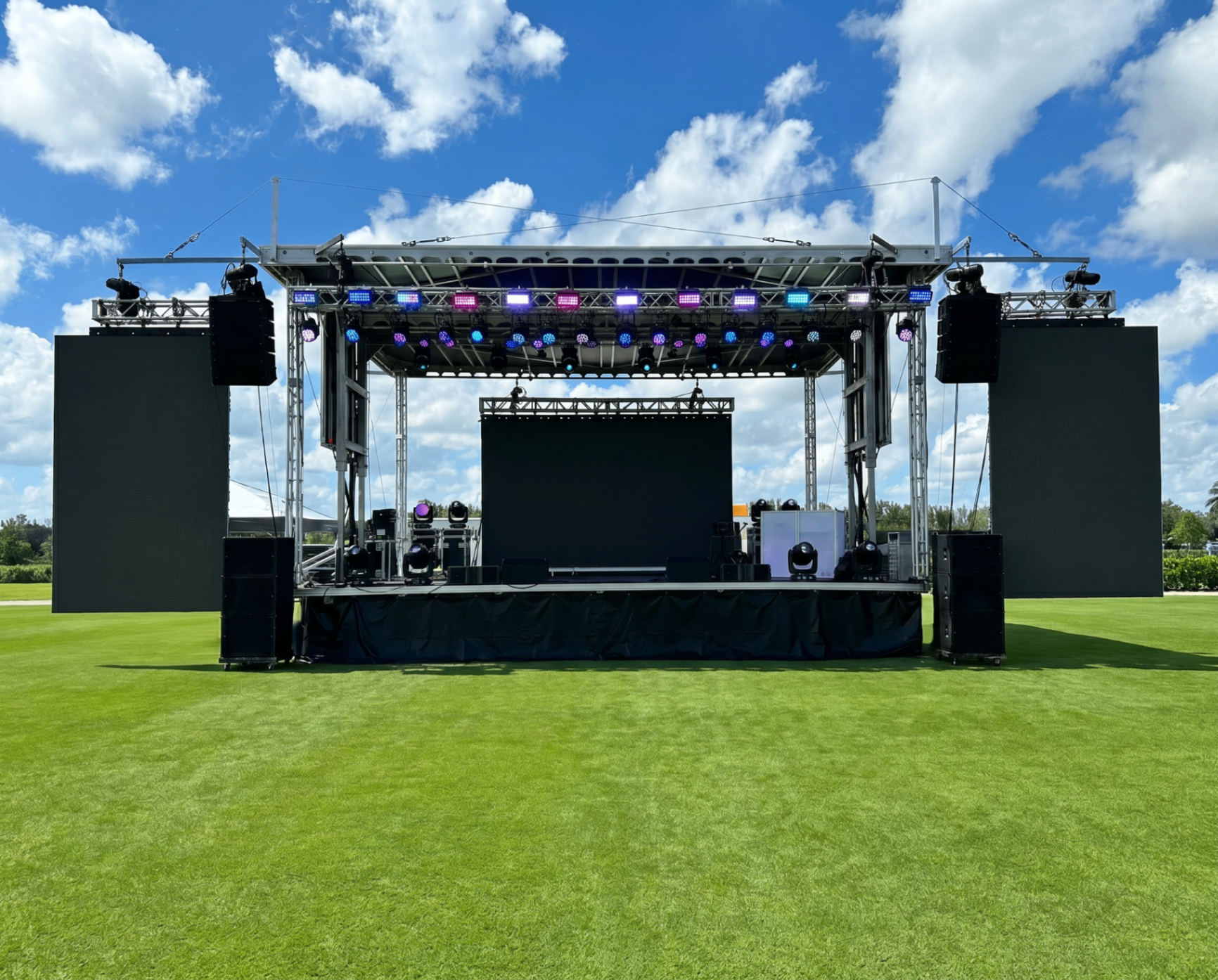
What a mobile stage actually is
A mobile stage is a pre-engineered performance platform that arrives on a trailer and deploys hydraulically into a fully rigged deck with a certified roof — usually in under an hour. It replaces two other things you might have considered: a scaffold stage built on-site from ground-support towers, or a stationary raised platform trucked in as separate pieces.
For outdoor events, mobile stages win on almost every axis: faster load-in, cleaner engineering paperwork, lower labor bill, and a finished look that reads as a "real concert stage" the moment it opens. The tradeoff is footprint — mobile stages come in fixed sizes and need a flat, truck-accessible site.
Picking the right size
Two questions decide the size: how many people are on stage at once, and how many people are watching. Everything else is detail.
24' x 24' — the Apex 2424
A 24-foot-wide deck comfortably holds a full band with monitors, a DJ booth with LED walls behind it, or a corporate keynote with a couch and a screen. It's the right pick when your crowd is under about 1,500 people, your budget is tight, or your site can't accommodate a wider footprint. See the Apex 2424 spec sheet for full dimensions.
32' x 24' — the Apex 3224
A 32-foot-wide deck is the festival standard. Headline touring rigs, drum risers, keyboard rigs, backline for a full band, and PA hangs on both sides all fit without crowding. If you're programming a headliner slot or expecting more than 2,500 people, step up to the Apex 3224.
Site requirements
Every mobile stage needs the same four things on-site. Get these right and load-in is smooth; miss one and you're calling us at 6 a.m. from a muddy field.
- Flat ground. Grass, packed dirt, asphalt, or concrete all work. Grade changes over a few inches across the footprint need to be shimmed — we bring the hardware, but factor extra setup time.
- Truck access. The trailer needs a straight run in and a pull-through or turnaround on the far side. Confirm gate widths and any overhead clearances (tree limbs, banners, power lines) before booking.
- Power. Choose between shore power (a dedicated 200A tie-in is typical for full production) or an onboard/tow-behind generator. GPS can quote either.
- Permits and insurance. Most municipalities require a temporary structure permit with stamped engineering drawings. GPS provides the drawings; the permit application is usually the venue's or the promoter's responsibility.
Weather, wind ratings, and safety
Every certified mobile stage has an engineered wind-load rating that varies by roof configuration and how much weight is rigged from the roof (lighting, video, banners). Those numbers aren't suggestions — they're the operating envelope your safety plan has to respect.
GPS supplies the full engineering package with every Apex rental, and our on-site crew monitors wind readings against the published limits throughout the show. If a squall line rolls in and speeds climb past the rating, the call is to lower banners, drop the roof if necessary, and pause the show — in that order. Build that decision authority into your run of show before doors open.
Booking timeline
For peak South Florida season — October through April, weekends, and any date within a week of a major holiday — book 8 to 12 weeks out. Off-season weekdays are usually workable at 4 to 6 weeks. Inside two weeks is sometimes possible; call and ask before assuming a date is closed.
On show day, a bare mobile stage deploys in under an hour of hydraulic setup. Add 2 to 4 hours for a full production load-in — line array flying, lighting rigging, video wall, cabling, sound check. Plan a half-day of on-site work for a full concert build, and a full day if your load-in window overlaps with vendor deliveries or crowd staging.
What actually drives the cost
Mobile stage quotes vary widely because the stage itself is often the smallest line item on a full production invoice. The bigger cost drivers:
- Production scope. Sound, lighting, and video packages usually cost more than the stage. Bundling with one vendor almost always comes in under booking each separately.
- Event length. Single-day events price differently than multi-day festivals where the stage sits on-site.
- Travel and lodging. Anything outside the South Florida metro adds mileage, per diems, and sometimes crew hotel rooms.
- Crew count. A full concert load-in needs riggers, audio techs, lighting techs, and a stage manager. Scaling crew up or down is the fastest lever on the quote.
- Weather contingencies. Rain covers, generator backup, and wind-monitoring gear are usually included for outdoor events but worth confirming line-by-line.
Frequently asked questions
How much does a mobile stage rental cost?
Mobile stage rental pricing depends on stage size, event length, travel distance, and what production packages you bundle in. A single-day 24-foot mobile stage in South Florida typically runs a few thousand dollars for the stage alone, and full-production days with sound, lighting, and video scale from there. Every GPS quote is custom — we price the exact scope, not a rate card.
What size mobile stage do I need?
For solo acts, DJs, and speaker events under about 1,500 attendees, a 24' x 24' stage like the Apex 2424 is usually the right call. For full bands, headline festival slots, and events over 2,500 attendees, step up to a 32' x 24' stage like the Apex 3224 so the backline, monitor world, and PA hangs all fit without crowding the performers.
How far in advance should I book a mobile stage?
For weekends in peak South Florida season (October through April), book 8 to 12 weeks out. For weekday corporate events or off-season dates, 4 to 6 weeks is usually workable. Last-minute bookings inside two weeks are sometimes possible, but options narrow fast — call and ask before assuming a date is closed.
Do mobile stages need permits?
Yes. Most municipalities require a temporary structure permit, and many also require engineered drawings, wind-load calculations, and a certificate of insurance. GPS provides stamped engineering drawings for the Apex 3224 and 2424 as part of every rental so your permit application isn't waiting on paperwork the day before load-in.
What wind speed is a mobile stage rated for?
Apex mobile stages are engineered to certified wind-load ratings that vary by roof configuration and rigging load. GPS provides the full engineering package with each stage so your production manager, safety officer, and local jurisdiction have documented ratings. On show day, our crew monitors wind and enforces the operating limits published in the engineering docs.
Can a mobile stage be set up indoors?
Technically yes — but it's rarely the right tool. Mobile stages are engineered to deploy from a trailer in an open outdoor footprint. Indoor events are almost always better served by a StageRight deck build or a ground-support roof system, both of which GPS provides. Ask us during quoting and we'll recommend the right platform.
How long does mobile stage setup take?
The Apex 3224 and 2424 both deploy from a single trailer to a fully rigged performance stage in under an hour of hydraulic setup. Add another 2 to 4 hours for full production load-in — line array hangs, lighting rigging, video walls, and cabling — depending on scope. Plan a half-day of on-site work for a full concert build.
What's the difference between a mobile stage and a scaffold stage?
A scaffold stage is built on-site from ground-support towers and decking — flexible in shape but slow to build and expensive in labor. A mobile stage arrives pre-engineered on a trailer and deploys hydraulically in under an hour. For one-day and weekend events, mobile stages are almost always faster, cleaner, and cheaper all-in than scaffold builds.
Next: production timeline and the outdoor rig
Once your stage is sized and booked, the event production checklist walks the week-by-week timeline from vendor lock through load-out, and the outdoor sound & lighting guide covers PA sizing, coverage, and power for open-air shows.
Ready to price your event?
Tell us your date, location, expected attendance, and what you need on stage — we'll send a tailored quote within one business day.
Request a Quote